2009年3月6日 星期五

Français Filtre (électronique) www.tool-tool.com

Bewise Inc. www.tool-tool.com Reference source from the internet.

Un filtre est un circuit électronique qui réalise une opération de traitement du signal. Autrement dit, il atténue certaines composantes d'un signal et en laisse passer d'autres. Un exemple connu du grand public est l'égaliseur audio.

Un filtre modifie (ou filtre) certaines parties d'un signal d'entrée dans le domaine temps et dans le domaine fréquence. D'après la théorie de Fourier, tout signal réel peut être considéré comme composé d'une somme de signaux sinusoïdaux (en nombre infini si nécessaire) à des fréquences différentes ; le rôle du filtre est de modifier la phase et l'amplitude de ces composantes.

Sommaire

[masquer]

Définition [modifier]

Filtre linéaire [modifier]

Icône de détail Article détaillé : Filtre linéaire.

Un filtre linéaire est caractérisé par l'existence d'une fonction h(t) telle que la réponse du filtre à tout signal d'entrée e(t) est:

s(t) = \int_{-\infty}^{+\infty} h(\tau).e(t-\tau).d\tau

Il s'agit bien du produit de convolution des fonctions h et e que l'on peut aussi noter :

s = h * e

h est appelée la réponse impulsionnelle du filtre. La connaitre permet de caractériser totalement le filtre.

Filtre non-linéaire [modifier]

Cette section est vide, pas assez détaillée ou incomplète. Votre aide est la bienvenue !

Historique [modifier]

Cette section est vide, pas assez détaillée ou incomplète. Votre aide est la bienvenue !

Classification [modifier]

Classification par type [modifier]

On peut classer les filtres à partir de la forme de leur fonction de transfert ou par le comportement des élements passifs qui composent le filtre. Les filtres les plus courants sont de l'un des quatre types suivants : passe-bas, passe-haut, passe-bande ou réjecteur de bande.

  • Un filtre passe-haut ne laisse passer que les fréquences au-dessus d'une fréquence déterminée, appelée fréquence de coupure. Il atténue les autres (basses fréquences). Autrement dit, il « laisse passer ce qui est haut ». C'est un atténuateur de graves pour un signal audio. On pourrait aussi l'appeler coupe-bas.
  • Un filtre passe-bas ne laisse passer que les fréquences au-dessous de sa fréquence de coupure. C'est un atténuateur d'aigües pour un signal audio. On pourrait l'appeler coupe-haut.
  • Un filtre passe-bande ne laisse passer qu'une certaine bande de fréquences (et atténue tout ce qui est au-dessus ou en dessous). Il est très utilisé dans les récepteurs radio, TV… pour isoler le signal que l'on désire capter.
  • Un filtre réjecteur, aussi appelé filtre trappe, cloche ou coupe-bande, est le complémentaire du passe-bande. Il atténue une plage de fréquences. Cela peut être utile pour diminuer certains parasites par exemple.
  • Un filtre passe-tout, également appelé filtre déphaseur ou cellule correctrice de phase, est un filtre qui a idéalement un gain unitaire sur toute la plage de fréquence utilisée. Il est utilisé pour modifier la phase d'un système.

Résultat de l'application d'un filtre passe-bas sur une image

Résultat de l'application d'un filtre passe-haut sur une image

Résultat de l'application d'un filtre passe-bande sur une image

Information
Cliquez sur une vignette pour l’agrandir.

Classification par technologie [modifier]

Filtre passif [modifier]

Filtre passif "passe-bas"

Un filtre passif se caractérise par l'usage exclusif de composants passifs (résistances, condensateurs, bobines couplées ou non). Par conséquent, leur gain (rapport de puissance entre la sortie et l'entrée) ne peut excéder 1. Autrement dit, ils ne peuvent qu'atténuer en partie des signaux, mais pas les amplifier car cela nécessiterait un apport d'énergie.

Les réalisations les plus simples sont basées sur des circuits RC, RL, LC ou Circuit RLC. Mais il est bien sûr permis d'augmenter la complexité du filtre (et le nombre de composants). Moins il y aura de composants, plus il sera délicat d'être sélectif : l'atténuation se fera progressivement. Avec plus de composants, on peut espérer couper plus brutalement une fréquence en touchant moins les voisines.

Les filtres passifs sont rarement sujets à des phénomènes de saturation (hormis quelques cas de bobines avec noyau) d'où par exemple leur usage dans les enceintes de haut-parleurs. De plus ils peuvent exister dans toutes les gammes de fréquences (d'où leur usage dans certains circuits haute fréquence comme en radio par exemple). Toutefois, un même circuit peut difficilement couvrir à lui seul une très large gamme de fréquences car le choix d'un type de bobine ou de condensateur dépend de la fréquence. C'est faisable mais plus complexe. Citons l'exemple du condensateur électrochimique : bien adapté aux basses fréquences, il devient assez vite inductif avec l'augmentation de la fréquence (il perd son comportement capacitif).

Une bobine est constituée d'un fil et est donc très conductrice en basse fréquence. Par contre, elle s'oppose au passage des hautes fréquences. Les condensateurs font l'inverse (isolant en basse fréquence, conducteur en haute fréquence). Les résistances ne sélectionnent pas les fréquences à elles seules, mais permettent de définir les constantes de temps d'un circuit en limitant plus ou moins les courants. Donc les résistances déterminent la fréquence à laquelle le filtre agira et son atténuation.

Au-delà de 100 MHz : les inductances sont souvent constituées par un simple fil sinueux ou des bandes de métal, et les condensateurs par des bandes de métal superposées (stubs). Par exemple sur les deux faces opposées d'un circuit imprimé.

Pour les filtres du second ordre, c'est-à-dire pouvant être décrits par une équation différentielle (linéaire très souvent) du second ordre, il est possible de définir un facteur de qualité, c’est-à-dire le rapport entre leur fréquence centrale et leur bande passante , attention ceci n'est valable que pour un passe-bande. Un filtre ayant une bande très fine par rapport à sa fréquence centrale sera considéré comme très sélectif ou de grande qualité.

Le circuit est soumis à plus ou moins de bruits parasites apparaissant dans les signaux. Cela dépend des composants employés. Bruit thermique très faible dans les résistances, bruit assez faible dans les condensateurs, mais sensibilité aux champs magnétiques plus importante avec les bobines.

Pour être complet, il convient de mentionner les filtres à quartz, les filtres à onde de surface (Surface Acoustic Waves filters ou SAW), les filtres céramique et les filtres mécaniques, qui font aussi partie des filtres passifs.
Ils peuvent être considérés dans le cas le plus général comme des quadripôles.

Filtre actif [modifier]

Icône de détail Article détaillé : Filtre actif.

Filtre actif "passe-bas"

Les filtres actifs se caractérisent par l'usage d'au moins un composant actif (par exemple transistor, amplificateur opérationnel, ou autre circuit intégré…).

Ces filtres ont l'avantage de pouvoir se passer de bobines qui sont chères, difficilement miniaturisables et imparfaites (angles de pertes, résonances propres, sensibilité aux parasites). De plus ils ont un gain qui peut être supérieur à 1 (ils peuvent amplifier).

Ce type de filtre convient bien aux signaux de faible amplitude et de faible puissance. Les filtres actifs sont donc largement utilisés dans les amplificateurs audio et instruments électroniques de toutes sortes.

Côté inconvénients, contrairement aux filtres passifs, ils nécessitent une alimentation électrique et sont limités en amplitude (saturation). Aujourd'hui ils peuvent couvrir de larges bandes de fréquences. Les composants actifs (ainsi que les résistances dans une moindre mesure) peuvent introduire du bruit parasite, ce qui, au-delà d'un certain seuil, peut être gênant. Toutefois ce bruit peut souvent être maîtrisé.

Filtre numérique [modifier]

Icône de détail Article détaillé : Filtre numérique.

Un filtre numérique se caractérise par le traitement entièrement numérique du signal. Au préalable, le signal analogique est filtré par un filtre antirepliement puis il est numérisé par un convertisseur analogique-numérique (CAN) qui généralement intègre un échantillonneur-bloqueur, c’est-à-dire qu’à intervalles réguliers (appelés période d’échantillonnage), l’amplitude instantanée du signal est échantillonné et maintenu puis quantifiée. On n’observe donc pas le signal en permanence et ces filtres réagissent donc assez mal face à des signaux (même parasites) de fréquence plus élevée que celle prévue (en l'absence de filtre anti-repliement).

Un filtre numérique traite un flot continu d'informations (comme par exemple celui d'une caméra vidéo) et calcule en temps réel un nouveau flot de données sortantes, qui correspondent au signal filtré désiré. Les données de sortie peuvent apparaître au même rythme ou à un rythme différent des données entrantes.

En bout de chaîne, le signal analogique est reconstruit par un convertisseur numérique-analogique (CNA) suivi d'un filtre de lissage. Les filtres numériques ont l’avantage de pouvoir être intégrés dans des circuits numériques miniaturisables à l’extrême, tels des processeurs (Digital Signal Processors, DSP en particulier). Les filtres analogiques ne sont pas supprimés pour autant (anti-repliement et lissage).

Les caractériques du filtre numérique sont invariable dans le temps, mais cela ne garanti pas que les caractériques d'un appareil qui en utilise seront invariables. Les CNA et CAN ne sont jamais parfaits et leurs caractériques varient d'un lot de composants à l'autre. Même si l'appareil ne possède pas de convertisseur (il reçoit une information numérique, la filtre puis la transmet en numérique) alors se pose le problème de la gigue d'horloge (les oscillateurs ne sont jamais parfaits) et de la synchronisation des données. Autre fait important, il existe deux types de filtre :

  • les filtre à réponse impulsionnelle finie (RIF),
  • les filtre à réponse impulsionnelle infinie (RII).

Si les premier sont toujours stables, ce n'est pas le cas pour les seconds.

Toutefois, les filtres numériques ont évidemment des limitations (arrondis de calcul, amplitude limitée, repliement de spectre…). Par contre ils offrent l’avantage de pouvoir être reprogrammés (éventuellement à la volée) pour changer de caractéristiques rapidement, sans changer de circuit matériel (sauf si le filtre numérique est réalisé par un ASIC).

Ils permettent d’obtenir des caractéristiques spectrales dont certaines ne peuvent être reproduites par aucun filtre analogique (actif ou non) : par exemple, ils peuvent être très sélectifs ou éliminer toute une série de composantes harmoniques (filtre en peigne). C’est uniquement une question de calcul mathématique.

La fréquence maximale du spectre du signal que traite un filtre numérique doit rester bien inférieure à la moitié de la fréquence d'échantillonnage (Théorème d'échantillonnage de Nyquist-Shannon), et que par conséquent le filtre numérique n'est pas adapté pour des signaux étalés sur une trop grande bande de fréquences. Il a fallu attendre la montée en puissance des capacités de calcul des processeurs pour voir apparaître ces filtres à grande échelle. Ils sont dorénavant très utilisés dans l’électronique moderne où l’analogique cède le pas au numérique. La plupart des signaux étant numériques ils sont traités directement comme tels.

Classification par spécificités [modifier]

Filtre à capacités commutées [modifier]

Icône de détail Article détaillé : Filtre à capacités commutées.

Les circuits à capacités commutées peuvent être utilisées pour la réalisation de filtres analogiques. Ils permettent une meilleure intégration, et un réglage aisé des fréquences de coupure.

Filtre piézoélectrique [modifier]

Icône de détail Article détaillé : Filtre BAW.

Les qualités piézoélectriques de certains matériaux, comme le quartz, peuvent être utilisées dans la conception de filtres. Les filtres à quartz possèdent un facteur de qualité élevé et une très bonne stabilité en température.

Filtre SAW [modifier]

Un filtre SAW (de l'anglais Surface Acoustic Wave, « onde acoustique de surface ») est un système électromécanique utilisé généralement dans des applications utilisant les ondes radio. Les signaux électriques sont convertis en onde mécanique par un cristal piézoélectrique. Cette onde est retardée lors de sa propagation dans le cristal, puis reconvertie en signal électrique. Les sorties retardées sont recombinées pour produire une implémentation d'un filtre à réponse impulsionnelle finie.

Filtre céramique [modifier]

Icône de détail Article détaillé : Filtre céramique.

Filtre atomique [modifier]

Pour des fréquences et une précision plus élevées, il est possible d'utiliser les modes vibratoires d'atomes. Les horloges atomiques utilisent des masers à césium comme filtres à très haut facteur de qualité afin de stabiliser leurs oscillateurs primaires. Une autre méthode, utilisée pour des fréquences élevées et fixes sur des signaux radio très faibles, est d'utiliser un laser à rubis.

Stabilité [modifier]

Icône de détail Article détaillé : Stabilité des filtres linéaires.

Synthèse [modifier]

Icône de détail Article détaillé : Synthèse des filtres linéaires.

La synthèse de filtres linéaires représente l'ensemble des outils mathématiques destinés à concevoir un filtre à partir de spécifications dans le domaine fréquentiel et/ou temporel.

Applications [modifier]

Tous les produits électroniques utilisent des filtres. On peut néanmoins citer dans le domaine des :

  • Télécommunications
    • Poste radio : sélection de la fréquence de chaque station émettrice.
    • Télévision : sélection des chaînes de télévision ou canaux.
    • Téléphone à touches : chaque touche envoie un signal de 2 fréquences précises qui « signent » un chiffre; avec 10 chiffres, on compose le numéro d'appel de son correspondant
    • ADSL : sur la même ligne téléphonique peuvent passer tout à la fois une conversation téléphonique BF ( basse fréquence: typiquement les fréquences audibles), le signal d'une chaîne télé (HF large bande), et le signal du IP (InternetProtocol). Voir Filtre ADSL et Filtre ADSL ISDN
  • Audio

Bibliographie [modifier]

Cette section est vide, pas assez détaillée ou incomplète. Votre aide est la bienvenue !

Notes [modifier]

Voir aussi [modifier]

Articles connexes [modifier]

歡迎來到Bewise Inc.的世界,首先恭喜您來到這接受新的資訊讓產業更有競爭力,我們是提供專業刀具製造商,應對客戶高品質的刀具需求,我們可以協助客戶滿足您對產業的不同要求,我們有能力達到非常卓越的客戶需求品質,這是現有相關技術無法比擬的,我們成功的滿足了各行各業的要求,包括:精密HSS DIN切削刀具協助客戶設計刀具流程DIN or JIS 鎢鋼切削刀具設計NAS986 NAS965 NAS897 NAS937orNAS907 航太切削刀具,NAS航太刀具設計超高硬度的切削刀具醫療配件刀具設計複合式再研磨機PCD地板專用企口鑽石組合刀具粉末造粒成型機主機版專用頂級電桿PCD V-Cut捨棄式圓鋸片組粉末成型機主機版專用頂級電感汽車業刀具設計電子產業鑽石刀具木工產業鑽石刀具銑刀與切斷複合再研磨機銑刀與鑽頭複合再研磨機銑刀與螺絲攻複合再研磨機等等。我們的產品涵蓋了從民生刀具到工業級的刀具設計;從微細刀具到大型刀具;從小型生產到大型量產;全自動整合;我們的技術可提供您連續生產的效能,我們整體的服務及卓越的技術,恭迎您親自體驗!!

BW Bewise Inc. Willy Chen willy@tool-tool.com bw@tool-tool.com www.tool-tool.com skype:willy_chen_bw mobile:0937-618-190 Head &Administration Office No.13,Shiang Shang 2nd St., West Chiu Taichung,Taiwan 40356 http://www.tool-tool.com / FAX:+886 4 2471 4839 N.Branch 5F,No.460,Fu Shin North Rd.,Taipei,Taiwan S.Branch No.24,Sec.1,Chia Pu East Rd.,Taipao City,Chiayi Hsien,Taiwan

Welcome to BW tool world! We are an experienced tool maker specialized in cutting tools. We focus on what you need and endeavor to research the best cutter to satisfy users demand. Our customers involve wide range of industries, like mold & die, aerospace, electronic, machinery, etc. We are professional expert in cutting field. We would like to solve every problem from you. Please feel free to contact us, its our pleasure to serve for you. BW product including: cutting toolaerospace tool .HSS DIN Cutting toolCarbide end millsCarbide cutting toolNAS Cutting toolNAS986 NAS965 NAS897 NAS937orNAS907 Cutting Tools,Carbide end milldisc milling cutter,Aerospace cutting toolhss drillФрезерыCarbide drillHigh speed steelCompound SharpenerMilling cutterINDUCTORS FOR PCDCVDD(Chemical Vapor Deposition Diamond )’PCBN (Polycrystalline Cubic Boron Nitride) Core drillTapered end millsCVD Diamond Tools Inserts’PCD Edge-Beveling Cutter(Golden FingerPCD V-CutterPCD Wood toolsPCD Cutting toolsPCD Circular Saw BladePVDD End Millsdiamond tool. INDUCTORS FOR PCD . POWDER FORMING MACHINE Single Crystal Diamond Metric end millsMiniature end millsСпециальные режущие инструментыПустотелое сверло Pilot reamerFraisesFresas con mango PCD (Polycrystalline diamond) ‘FresePOWDER FORMING MACHINEElectronics cutterStep drillMetal cutting sawDouble margin drillGun barrelAngle milling cutterCarbide burrsCarbide tipped cutterChamfering toolIC card engraving cutterSide cutterStaple CutterPCD diamond cutter specialized in grooving floorsV-Cut PCD Circular Diamond Tipped Saw Blade with Indexable Insert PCD Diamond Tool Saw Blade with Indexable InsertNAS toolDIN or JIS toolSpecial toolMetal slitting sawsShell end millsSide and face milling cuttersSide chip clearance sawsLong end millsend mill grinderdrill grindersharpenerStub roughing end millsDovetail milling cuttersCarbide slot drillsCarbide torus cuttersAngel carbide end millsCarbide torus cuttersCarbide ball-nosed slot drillsMould cutterTool manufacturer.

Bewise Inc. www.tool-tool.com

ようこそBewise Inc.の世界へお越し下さいませ、先ず御目出度たいのは新たな

情報を受け取って頂き、もっと各産業に競争力プラス展開。

弊社は専門なエンドミルの製造メーカーで、客先に色んな分野のニーズ

豊富なパリエーションを満足させ、特にハイテク品質要求にサポート致します。

弊社は各領域に供給できる内容は:

(1)精密HSSエンドミルのR&D

(2)Carbide Cutting tools設計

(3)鎢鋼エンドミル設計

(4)航空エンドミル設計

(5)超高硬度エンドミル

(6)ダイヤモンドエンドミル

(7)医療用品エンドミル設計

(8)自動車部品&材料加工向けエンドミル設計

弊社の製品の供給調達機能は:

(1)生活産業~ハイテク工業までのエンドミル設計

(2)ミクロエンドミル~大型エンドミル供給

(3)小Lot生産~大量発注対応供給

(4)オートメーション整備調達

(5)スポット対応~流れ生産対応

弊社の全般供給体制及び技術自慢の総合専門製造メーカーに貴方のご体験を御待ちしております。

Bewise Inc. talaşlı imalat sanayinde en fazla kullanılan ve üç eksende (x,y,z) talaş kaldırabilen freze takımlarından olan Parmak Freze imalatçısıdır. Çok geniş ürün yelpazesine sahip olan firmanın başlıca ürünlerini Karbür Parmak Frezeler, Kalıpçı Frezeleri, Kaba Talaş Frezeleri, Konik Alın Frezeler, Köşe Radyüs Frezeler, İki Ağızlı Kısa ve Uzun Küresel Frezeler, İç Bükey Frezeler vb. şeklinde sıralayabiliriz.

BW специализируется в научных исследованиях и разработках, и снабжаем самым высокотехнологичным карбидовым материалом для поставки режущих / фрезеровочных инструментов для почвы, воздушного пространства и электронной индустрии. В нашу основную продукцию входит твердый карбид / быстрорежущая сталь, а также двигатели, микроэлектрические дрели, IC картонорезальные машины, фрезы для гравирования, режущие пилы, фрезеры-расширители, фрезеры-расширители с резцом, дрели, резаки форм для шлицевого вала / звездочки роликовой цепи, и специальные нано инструменты. Пожалуйста, посетите сайт www.tool-tool.com для получения большей информации.

BW is specialized in R&D and sourcing the most advanced carbide material with high-tech coating to supply cutting / milling tool for mould & die, aero space and electronic industry. Our main products include solid carbide / HSS end mills, micro electronic drill, IC card cutter, engraving cutter, shell end mills, cutting saw, reamer, thread reamer, leading drill, involute gear cutter for spur wheel, rack and worm milling cutter, thread milling cutter, form cutters for spline shaft/roller chain sprocket, and special tool, with nano grade. Please visit our web www.tool-tool.com for more info.

Español Filtro electrónico www.tool-tool.com

Bewise Inc. www.tool-tool.com Reference source from the internet.

Un filtro eléctrico o filtro electrónico es un elemento que discrimina una determinada frecuencia o gama de frecuencias de una señal eléctrica que pasa a través de él, pudiendo modificar tanto su amplitud como su fase.

Contenido

[ocultar]

Características [editar]

Las características que definen un filtro vienen determinadas por los siguientes conceptos:

Función de transferencia [editar]

Con independencia de la realización concreta del filtro (analógico, digital o mecánico) la forma de comportarse de un filtro se describe por su función de transferencia. Ésta determina la forma en que la señal aplicada cambia en amplitud y en fase al atravesar el filtro. La función de transferencia elegida tipifica el filtro. Algunos filtros habituales son:

  • Filtro de Butterworth, con una banda de paso suave y un corte agudo
  • Filtro de Chebyshov, con un corte agudo pero con una banda de paso con ondulaciones
  • Filtros elípticos o filtro de Cauer, que consiguen una zona de transición más abrupta que los anteriores a costa de oscilaciones en todas sus bandas
  • Filtro de Bessel, que, en el caso de ser analógico, aseguran una variación de fase constante

Imagen:filtros_electr.PNG

Se puede llegar a expresar matemáticamente la función de transferencia en forma de fracción mediante las transformaciones en frecuencia adecuadas. Se dice que los valores que hacen nulo el numerador son los ceros y los que hacen nulo el denominador son polos.

H(f)=\frac{numerador(f)}{denominador(f)}

El número de polos y ceros indica el orden del filtro y su valor determina las características del filtro, como su respuesta en frecuencia y su estabilidad.

Orden [editar]

El orden de un filtro describe el grado de aceptación o rechazo de frecuencias por arriba o por debajo, de la respectiva frecuencia de corte. Un filtro de primer orden, cuya frecuencia de corte sea igual a (F), presentará una atenuación de 6 dB en la primera octava (2F), 12 dB en la segunda octava (4F), 18 dB en la tercer octava (8F) y así sucesivamente. Uno de segundo orden tendría el doble de pendiente (representado en escala logarítmica). Esto se relaciona con los polos y ceros: los polos hacen que la pendiente baje con 20 dB por década y los ceros que suba también con 20 dB por década, de esta forma los polos y ceros pueden compensar su efecto.

Imagen:filt_elect_pend.PNG

Para realizar filtros analógicos de órdenes más altos se suele realizar una conexión en serie de filtros de 1º o 2º orden debido a que a mayor orden el filtro se hace más complejo. Sin embargo, en el caso de filtros digitales es habitual obtener órdenes superiores a 100.

Tipos de filtro [editar]

Atendiendo a sus componentes constitutivos, naturaleza de las señales que tratan, respuesta en frecuencia y método de diseño, los filtros se clasifican en los distintos grupos que a continuación se indica.

Según respuesta frecuencia [editar]
  • Filtro paso bajo: Es aquel que permite el paso de frecuencias bajas, desde frecuencia 0 o continua hasta una determinada. Presentan ceros a alta frecuencia y polos a bajas frecuencia.
  • Filtro paso alto: Es el que permite el paso de frecuencias desde una frecuencia de corte determinada hacia arriba, sin que exista un límite superior especificado. Presentan ceros a bajas frecuencias y polos a altas frecuencias.
  • Filtro paso banda: Son aquellos que permiten el paso de componentes frecuenciales contenidos en un determinado rango de frecuencias, comprendido entre una frecuencia de corte superior y otra inferior.
  • Filtro elimina banda: También llamado filtro rechaza banda, es el que dificulta el paso de componentes frecuenciales contenidos en un determinado rango de frecuencias, comprendido entre una frecuencia de corte superior y otra inferior.
  • Filtro multibanda: Es que presenta varios rangos de frecuencias en los cuales hay un comportamiento diferente.
  • Filtro variable: Es aquel que puede cambiar sus márgenes de frecuencia.

Filtros activos y pasivos [editar]

Filtros analógicos o digitales [editar]

Atendiendo a la naturaleza de las señales tratadas los filtros pueden ser:

Otros filtros [editar]

Otro tipo de filtro puede ser la ferrita que hay en muchos cables, por ejemplo en el de las pantallas de ordenador, que tiene la propiedad de presentar distinta impedancia a alta y baja frecuencia.

Véase también [editar]

歡迎來到Bewise Inc.的世界,首先恭喜您來到這接受新的資訊讓產業更有競爭力,我們是提供專業刀具製造商,應對客戶高品質的刀具需求,我們可以協助客戶滿足您對產業的不同要求,我們有能力達到非常卓越的客戶需求品質,這是現有相關技術無法比擬的,我們成功的滿足了各行各業的要求,包括:精密HSS DIN切削刀具協助客戶設計刀具流程DIN or JIS 鎢鋼切削刀具設計NAS986 NAS965 NAS897 NAS937orNAS907 航太切削刀具,NAS航太刀具設計超高硬度的切削刀具醫療配件刀具設計複合式再研磨機PCD地板專用企口鑽石組合刀具粉末造粒成型機主機版專用頂級電桿PCD V-Cut捨棄式圓鋸片組粉末成型機主機版專用頂級電感汽車業刀具設計電子產業鑽石刀具木工產業鑽石刀具銑刀與切斷複合再研磨機銑刀與鑽頭複合再研磨機銑刀與螺絲攻複合再研磨機等等。我們的產品涵蓋了從民生刀具到工業級的刀具設計;從微細刀具到大型刀具;從小型生產到大型量產;全自動整合;我們的技術可提供您連續生產的效能,我們整體的服務及卓越的技術,恭迎您親自體驗!!

BW Bewise Inc. Willy Chen willy@tool-tool.com bw@tool-tool.com www.tool-tool.com skype:willy_chen_bw mobile:0937-618-190 Head &Administration Office No.13,Shiang Shang 2nd St., West Chiu Taichung,Taiwan 40356 http://www.tool-tool.com / FAX:+886 4 2471 4839 N.Branch 5F,No.460,Fu Shin North Rd.,Taipei,Taiwan S.Branch No.24,Sec.1,Chia Pu East Rd.,Taipao City,Chiayi Hsien,Taiwan

Welcome to BW tool world! We are an experienced tool maker specialized in cutting tools. We focus on what you need and endeavor to research the best cutter to satisfy users demand. Our customers involve wide range of industries, like mold & die, aerospace, electronic, machinery, etc. We are professional expert in cutting field. We would like to solve every problem from you. Please feel free to contact us, its our pleasure to serve for you. BW product including: cutting toolaerospace tool .HSS DIN Cutting toolCarbide end millsCarbide cutting toolNAS Cutting toolNAS986 NAS965 NAS897 NAS937orNAS907 Cutting Tools,Carbide end milldisc milling cutter,Aerospace cutting toolhss drillФрезерыCarbide drillHigh speed steelCompound SharpenerMilling cutterINDUCTORS FOR PCDCVDD(Chemical Vapor Deposition Diamond )’PCBN (Polycrystalline Cubic Boron Nitride) Core drillTapered end millsCVD Diamond Tools Inserts’PCD Edge-Beveling Cutter(Golden FingerPCD V-CutterPCD Wood toolsPCD Cutting toolsPCD Circular Saw BladePVDD End Millsdiamond tool. INDUCTORS FOR PCD . POWDER FORMING MACHINE Single Crystal Diamond Metric end millsMiniature end millsСпециальные режущие инструментыПустотелое сверло Pilot reamerFraisesFresas con mango PCD (Polycrystalline diamond) ‘FresePOWDER FORMING MACHINEElectronics cutterStep drillMetal cutting sawDouble margin drillGun barrelAngle milling cutterCarbide burrsCarbide tipped cutterChamfering toolIC card engraving cutterSide cutterStaple CutterPCD diamond cutter specialized in grooving floorsV-Cut PCD Circular Diamond Tipped Saw Blade with Indexable Insert PCD Diamond Tool Saw Blade with Indexable InsertNAS toolDIN or JIS toolSpecial toolMetal slitting sawsShell end millsSide and face milling cuttersSide chip clearance sawsLong end millsend mill grinderdrill grindersharpenerStub roughing end millsDovetail milling cuttersCarbide slot drillsCarbide torus cuttersAngel carbide end millsCarbide torus cuttersCarbide ball-nosed slot drillsMould cutterTool manufacturer.

Bewise Inc. www.tool-tool.com

ようこそBewise Inc.の世界へお越し下さいませ、先ず御目出度たいのは新たな

情報を受け取って頂き、もっと各産業に競争力プラス展開。

弊社は専門なエンドミルの製造メーカーで、客先に色んな分野のニーズ

豊富なパリエーションを満足させ、特にハイテク品質要求にサポート致します。

弊社は各領域に供給できる内容は:

(1)精密HSSエンドミルのR&D

(2)Carbide Cutting tools設計

(3)鎢鋼エンドミル設計

(4)航空エンドミル設計

(5)超高硬度エンドミル

(6)ダイヤモンドエンドミル

(7)医療用品エンドミル設計

(8)自動車部品&材料加工向けエンドミル設計

弊社の製品の供給調達機能は:

(1)生活産業~ハイテク工業までのエンドミル設計

(2)ミクロエンドミル~大型エンドミル供給

(3)小Lot生産~大量発注対応供給

(4)オートメーション整備調達

(5)スポット対応~流れ生産対応

弊社の全般供給体制及び技術自慢の総合専門製造メーカーに貴方のご体験を御待ちしております。

Bewise Inc. talaşlı imalat sanayinde en fazla kullanılan ve üç eksende (x,y,z) talaş kaldırabilen freze takımlarından olan Parmak Freze imalatçısıdır. Çok geniş ürün yelpazesine sahip olan firmanın başlıca ürünlerini Karbür Parmak Frezeler, Kalıpçı Frezeleri, Kaba Talaş Frezeleri, Konik Alın Frezeler, Köşe Radyüs Frezeler, İki Ağızlı Kısa ve Uzun Küresel Frezeler, İç Bükey Frezeler vb. şeklinde sıralayabiliriz.

BW специализируется в научных исследованиях и разработках, и снабжаем самым высокотехнологичным карбидовым материалом для поставки режущих / фрезеровочных инструментов для почвы, воздушного пространства и электронной индустрии. В нашу основную продукцию входит твердый карбид / быстрорежущая сталь, а также двигатели, микроэлектрические дрели, IC картонорезальные машины, фрезы для гравирования, режущие пилы, фрезеры-расширители, фрезеры-расширители с резцом, дрели, резаки форм для шлицевого вала / звездочки роликовой цепи, и специальные нано инструменты. Пожалуйста, посетите сайт www.tool-tool.com для получения большей информации.

BW is specialized in R&D and sourcing the most advanced carbide material with high-tech coating to supply cutting / milling tool for mould & die, aero space and electronic industry. Our main products include solid carbide / HSS end mills, micro electronic drill, IC card cutter, engraving cutter, shell end mills, cutting saw, reamer, thread reamer, leading drill, involute gear cutter for spur wheel, rack and worm milling cutter, thread milling cutter, form cutters for spline shaft/roller chain sprocket, and special tool, with nano grade. Please visit our web www.tool-tool.com for more info.

English Electronic filter www.tool-tool.com

Bewise Inc. www.tool-tool.com Reference source from the internet.

Jump to: navigation, search

Television signal splitter consisting of a high-pass filter (left) and a low-pass filter (right). The antenna is connected to the screw terminals to the left of center.

Electronic filters are electronic circuits which perform signal processing functions, specifically to remove unwanted frequency components from the signal and/or to enhance wanted ones. Electronic filters can be:

The most common types of electronic filters are linear filters, regardless of other aspects of their design. See the article on linear filters for details on their design and analysis.

Contents

[hide]

[edit] History

The oldest forms of electronic filters are passive analog linear filters, constructed using only resistors and capacitors or resistors and inductors. These are known as RC and RL single pole filters respectively. More complex multipole LC filters have also existed for many years and the operation of such filters is well understood with many books having been written about them.

Hybrid filters have also been made, typically involving combinations of analog amplifiers with mechanical resonators or delay lines. Other devices such as CCD delay lines have also been used as discrete-time filters. With the availability of digital signal processing, active digital filters have become common.

[edit] Classification by technology

[edit] Passive filters

Passive implementations of linear filters are based on combinations of resistors (R), inductors (L) and capacitors (C). These types are collectively known as passive filters, because they do not depend upon an external power supply.

Inductors block high-frequency signals and conduct low-frequency signals, while capacitors do the reverse. A filter in which the signal passes through an inductor, or in which a capacitor provides a path to ground, presents less attenuation to low-frequency signals than high-frequency signals and is a low-pass filter. If the signal passes through a capacitor, or has a path to ground through an inductor, then the filter presents less attenuation to high-frequency signals than low-frequency signals and is a high-pass filter. Resistors on their own have no frequency-selective properties, but are added to inductors and capacitors to determine the time-constants of the circuit, and therefore the frequencies to which it responds.

The inductors and capacitors are the reactive elements of the filter. The number of elements determines the order of the filter. In this context, an LC tuned circuit being used in a band-pass or band-stop filter is considered a single element even though it consists of two components.

At high frequencies (above about 100 megahertz), sometimes the inductors consist of single loops or strips of sheet metal, and the capacitors consist of adjacent strips of metal. These inductive or capacitive pieces of metal are called stubs.

[edit] Single element types

A low-pass electronic filter realised by an RC circuit

The simplest passive filters consist of a single reactive element. These are constructed of RC, RL, LC or RLC elements.

The quality or "Q" factor is a measure that is sometimes used to describe simple band-pass or band-stop filters. A filter is said to have a high Q if it selects or rejects a range of frequencies that is narrow in comparison to the centre frequency. Q may be defined for bandpass and band-reject filters as the ratio of centre frequency divided by 3dB bandwidth. It is not commonly employed with higher order filters where other parameters are of more concern, and for high-pass or low-pass filters Q is not normally related to bandwidth.

[edit] L filter

An L filter consists of two reactive elements, one in series and one in parallel.

[edit] T and π filters

Low-pass π filter

High-pass T filter

Three-element filters can have a 'T' or 'π' topology and in either geometries, a low-pass, high-pass, band-pass, or band-stop characteristic is possible. The components can be chosen symmetric or not, depending on the required frequency characteristics. The high-pass T filter in the illustration, has a very low impedance at high frequencies, and a very high impedance at low frequencies. That means that it can be inserted in a transmission line, resulting in the high frequencies being passed and low frequencies being reflected. Likewise, for the illustrated low-pass π filter, the circuit can be connected to a transmission line, transmitting low frequencies and reflecting high frequencies. Using m-derived filter sections with correct termination impedances, the input impedance can be reasonably constant in the pass band[1].

[edit] Multiple element types

Multiple element filters are usually constructed as a ladder network. These can be seen as a continuation of the L,T and π designs of filters. More elements are needed when it is desired to improve some parameter of the filter such as stop-band rejection or slope of transition from pass-band to stop-band.

[edit] Active filters

Active filters are implemented using a combination of passive and active (amplifying) components, and require an outside power source. Operational amplifiers are frequently used in active filter designs. These can have high Q, and can achieve resonance without the use of inductors. However, their upper frequency limit is limited by the bandwidth of the amplifiers used.

[edit] Digital filters

A finite impulse response filter

Digital signal processing allows the inexpensive construction of a wide variety of filters. The signal is sampled and an analog to digital converter turns the signal into a stream of numbers. A computer program running on a CPU or a specialized DSP (or less often running on a hardware implementation of the algorithm) calculates an output number stream. This output can be converted to a signal by passing it through a digital to analog converter. There are problems with noise introduced by the conversions, but these can be controlled and limited for many useful filters. Due to the sampling involved, the input signal must be of limited frequency content or aliasing will occur. See also: Digital filter.

[edit] Other filter technologies

[edit] Quartz filters and piezoelectrics

In the late 1930s, engineers realized that small mechanical systems made of rigid materials such as quartz would acoustically resonate at radio frequencies, i.e. from audible frequencies (sound) up to several hundred megahertz. Some early resonators were made of steel, but quartz quickly became favored. The biggest advantage of quartz is that it is piezoelectric. This means that quartz resonators can directly convert their own mechanical motion into electrical signals. Quartz also has a very low coefficient of thermal expansion which means that quartz resonators can produce stable frequencies over a wide temperature range. Quartz crystal filters have much higher quality factors than LCR filters. When higher stabilities are required, the crystals and their driving circuits may be mounted in a "crystal oven" to control the temperature. For very narrow band filters, sometimes several crystals are operated in series.

Engineers realized that a large number of crystals could be collapsed into a single component, by mounting comb-shaped evaporations of metal on a quartz crystal. In this scheme, a "tapped delay line" reinforces the desired frequencies as the sound waves flow across the surface of the quartz crystal. The tapped delay line has become a general scheme of making high-Q filters in many different ways.

[edit] SAW filters

SAW (surface acoustic wave) filters are electromechanical devices commonly used in radio frequency applications. Electrical signals are converted to a mechanical wave in a device constructed of a piezoelectric crystal or ceramic; this wave is delayed as it propagates across the device, before being converted back to an electrical signal by further electrodes. The delayed outputs are recombined to produce a direct analog implementation of a finite impulse response filter. This hybrid filtering technique is also found in an analog sampled filter. SAW filters are limited to frequencies up to 3 GHz.

[edit] BAW filters

BAW (Bulk Acoustic Wave) filters are electromechanical devices. BAW filters can implement ladder or lattice filters. BAW filters typically operate at frequencies from around 2 to around 16 GHz, and in may be smaller or thinner than equivalent SAW filters. Two main variants of BAW filters are making their way into devices, Thin film bulk acoustic resonator or FBAR and Solid Mounted Bulk Acoustic Resonators.

[edit] Garnet filters

Main article: Yttrium iron garnet filter

Another method of filtering, at microwave frequencies from 800 MHz to about 5 GHz, is to use a synthetic single crystal yttrium iron garnet sphere made of a chemical combination of yttrium and iron (YIGF, or yttrium iron garnet filter). The garnet sits on a strip of metal driven by a transistor, and a small loop antenna touches the top of the sphere. An electromagnet changes the frequency that the garnet will pass. The advantage of this method is that the garnet can be tuned over a very wide frequency by varying the strength of the magnetic field.

[edit] Atomic filters

For even higher frequencies and greater precision, the vibrations of atoms must be used. Atomic clocks use caesium masers as ultra-high Q filters to stabilize their primary oscillators. Another method, used at high, fixed frequencies with very weak radio signals, is to use a ruby maser tapped delay line.

[edit] The transfer function

The transfer function \ H(s) of a filter is the ratio of the output signal \ Y(s) to that of the input signal \ X(s) as a function of the complex frequency \ s:

\ H(s)=\frac{Y(s)}{X(s)}

with \ s = \sigma + j \omega.

The transfer function of all linear time-invariant filters generally share certain characteristics:

  • Since the filters are constructed of discrete components, their transfer function will be the ratio of two polynomials in \ s, i.e. a rational function of \ s. The order of the transfer function will be the highest power of \ s encountered in either the numerator or the denominator.
  • The polynomials of the transfer function will all have real coefficients. Therefore, the poles and zeroes of the transfer function will either be real or occur in complex conjugate pairs.
  • Since the filters are assumed to be stable, the real part of all poles (i.e. zeroes of the denominator) will be negative, i.e. they will lie in the left half-plane in complex frequency space.

The proper construction of a transfer function involves the Laplace transform, and therefore it is needed to assume null initial conditions, because

\mathcal{L}\left\{\frac{df}{dt}\right\} = s\cdot\mathcal{L} \left\{ f(t) \right\}-f(0),

And when f(0)=0 we can get rid of the constants and use the usual expression

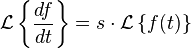
\mathcal{L}\left\{\frac{df}{dt}\right\} = s\cdot\mathcal{L} \left\{ f(t) \right\}

An alternative to transfer functions is to give the behavior of the filter as a convolution. The convolution theorem, which holds for Laplace transforms, guarantees equivalence with transfer functions.

[edit] Classification by transfer function

Main article: transfer function

Filters may be specified by family and passband. A filter's family is specified by certain design criteria which give general rules for specifying the transfer function of the filter. Some common filter families and their particular design criteria are:

Generally, each family of filters can be specified to a particular order. The higher the order, the more the filter will approach the "ideal" filter. The ideal filter has full transmission in the pass band, and complete attenuation in the stop band, and the transition between the two bands is abrupt (often called brick-wall).

Here is an image comparing Butterworth, Chebyshev, and elliptic filters. The filters in this illustration are all fifth-order low-pass filters. The particular implementation -- analog or digital, passive or active -- makes no difference; their output would be the same.

As is clear from the image, elliptic filters are sharper than all the others, but they show ripples on the whole bandwidth.

Each family can be used to specify a particular pass band in which frequencies are transmitted, while frequencies in the stop band (i.e. outside the pass band) are more or less attenuated.

The family and passband of a filter completely specify the transfer function of a filter. The transfer function completely specifies the behavior of a linear filter, but not the particular technology used to implement it. In other words, there are a number of different ways of achieving a particular transfer function when designing a circuit. A particular pass band filter can be obtained by transformation of a prototype filter of that class.

[edit] Classification by topology

Electronic filters can be classified by the technology used to implement them. Filters using passive filter and active filter technology can be further classified by the particular electronic filter topology used to implement them.

Any given filter transfer function may be implemented in any electronic filter topology.

Some common circuit topologies are:

[edit] Classification by design methodology

Linear analog electronic filters

Network synthesis filters[hide]

Image impedance filters[hide]

Simple filters[hide]

edit

Historically, linear analog filter design has evolved through three major approaches. The oldest designs are simple circuits where the main design criterion was the Q factor of the circuit. This reflected the radio receiver application of filtering as Q was a measure of the frequency selectivity of a tuning circuit. From the 1920s filters began to be designed from the image point of view, mostly being driven by the requirements of telecommunications. After World War II the dominant methodology was network synthesis. The higher mathematics used originally required extensive tables of polynomial coefficient values to be published but modern computer resources have made that unnecessary.[2]

[edit] Direct circuit analysis

Low order filters can be designed by directly applying basic circuit laws such as Kirchoff's laws to obtain the transfer function. This kind of analysis is usually only carried out for simple filters of 1st or 2nd order.

RL filter frequency response

[edit] Image impedance analysis

Main article: Composite image filters

This approach analyses the filter sections from the point of view of the filter being in an infinite chain of identical sections. It has the advantages of simplicity of approach and the ability to easily extend to higher orders. It has the disadvantage that accuracy of predicted responses rely on filter terminations in the image impedance, which is usually not the case.[3]

Constant k filter response with 5 elements

Zobel network (constant R) filter, 5 sections

m-derived filter response, m=0.5, 2 elements

m-derived filter response, m=0.5, 5 elements

[edit] Network synthesis

Main article: Network synthesis filters

The network synthesis approach starts with a required transfer function and then expresses that as a polynomial equation of the input impedance of the filter. The actual element values of the filter are obtained by continued-fraction or partial-fraction expansions of this polynomial. Unlike the image method, there is no need for impedance matching networks at the terminations as the effects of the terminating resistors are included in the analysis from the start.[3]

[edit] See also

[edit] External links and references

  1. ^ The American Radio Relay League, Inc.: "The ARRL Handbook, 1968" page 50
  2. ^ Bray, J, Innovation and the Communications Revolution, Institute of Electrical Engineers
  3. ^ a b Matthaei, Young, Jones Microwave Filters, Impedance-Matching Networks, and Coupling Structures McGraw-Hill 1964

歡迎來到Bewise Inc.的世界,首先恭喜您來到這接受新的資訊讓產業更有競爭力,我們是提供專業刀具製造商,應對客戶高品質的刀具需求,我們可以協助客戶滿足您對產業的不同要求,我們有能力達到非常卓越的客戶需求品質,這是現有相關技術無法比擬的,我們成功的滿足了各行各業的要求,包括:精密HSS DIN切削刀具協助客戶設計刀具流程DIN or JIS 鎢鋼切削刀具設計NAS986 NAS965 NAS897 NAS937orNAS907 航太切削刀具,NAS航太刀具設計超高硬度的切削刀具醫療配件刀具設計複合式再研磨機PCD地板專用企口鑽石組合刀具粉末造粒成型機主機版專用頂級電桿PCD V-Cut捨棄式圓鋸片組粉末成型機主機版專用頂級電感汽車業刀具設計電子產業鑽石刀具木工產業鑽石刀具銑刀與切斷複合再研磨機銑刀與鑽頭複合再研磨機銑刀與螺絲攻複合再研磨機等等。我們的產品涵蓋了從民生刀具到工業級的刀具設計;從微細刀具到大型刀具;從小型生產到大型量產;全自動整合;我們的技術可提供您連續生產的效能,我們整體的服務及卓越的技術,恭迎您親自體驗!!

BW Bewise Inc. Willy Chen willy@tool-tool.com bw@tool-tool.com www.tool-tool.com skype:willy_chen_bw mobile:0937-618-190 Head &Administration Office No.13,Shiang Shang 2nd St., West Chiu Taichung,Taiwan 40356 http://www.tool-tool.com / FAX:+886 4 2471 4839 N.Branch 5F,No.460,Fu Shin North Rd.,Taipei,Taiwan S.Branch No.24,Sec.1,Chia Pu East Rd.,Taipao City,Chiayi Hsien,Taiwan

Welcome to BW tool world! We are an experienced tool maker specialized in cutting tools. We focus on what you need and endeavor to research the best cutter to satisfy users demand. Our customers involve wide range of industries, like mold & die, aerospace, electronic, machinery, etc. We are professional expert in cutting field. We would like to solve every problem from you. Please feel free to contact us, its our pleasure to serve for you. BW product including: cutting toolaerospace tool .HSS DIN Cutting toolCarbide end millsCarbide cutting toolNAS Cutting toolNAS986 NAS965 NAS897 NAS937orNAS907 Cutting Tools,Carbide end milldisc milling cutter,Aerospace cutting toolhss drillФрезерыCarbide drillHigh speed steelCompound SharpenerMilling cutterINDUCTORS FOR PCDCVDD(Chemical Vapor Deposition Diamond )’PCBN (Polycrystalline Cubic Boron Nitride) Core drillTapered end millsCVD Diamond Tools Inserts’PCD Edge-Beveling Cutter(Golden FingerPCD V-CutterPCD Wood toolsPCD Cutting toolsPCD Circular Saw BladePVDD End Millsdiamond tool. INDUCTORS FOR PCD . POWDER FORMING MACHINE Single Crystal Diamond Metric end millsMiniature end millsСпециальные режущие инструментыПустотелое сверло Pilot reamerFraisesFresas con mango PCD (Polycrystalline diamond) ‘FresePOWDER FORMING MACHINEElectronics cutterStep drillMetal cutting sawDouble margin drillGun barrelAngle milling cutterCarbide burrsCarbide tipped cutterChamfering toolIC card engraving cutterSide cutterStaple CutterPCD diamond cutter specialized in grooving floorsV-Cut PCD Circular Diamond Tipped Saw Blade with Indexable Insert PCD Diamond Tool Saw Blade with Indexable InsertNAS toolDIN or JIS toolSpecial toolMetal slitting sawsShell end millsSide and face milling cuttersSide chip clearance sawsLong end millsend mill grinderdrill grindersharpenerStub roughing end millsDovetail milling cuttersCarbide slot drillsCarbide torus cuttersAngel carbide end millsCarbide torus cuttersCarbide ball-nosed slot drillsMould cutterTool manufacturer.

Bewise Inc. www.tool-tool.com

ようこそBewise Inc.の世界へお越し下さいませ、先ず御目出度たいのは新たな

情報を受け取って頂き、もっと各産業に競争力プラス展開。

弊社は専門なエンドミルの製造メーカーで、客先に色んな分野のニーズ

豊富なパリエーションを満足させ、特にハイテク品質要求にサポート致します。

弊社は各領域に供給できる内容は:

(1)精密HSSエンドミルのR&D

(2)Carbide Cutting tools設計

(3)鎢鋼エンドミル設計

(4)航空エンドミル設計

(5)超高硬度エンドミル

(6)ダイヤモンドエンドミル

(7)医療用品エンドミル設計

(8)自動車部品&材料加工向けエンドミル設計

弊社の製品の供給調達機能は:

(1)生活産業~ハイテク工業までのエンドミル設計

(2)ミクロエンドミル~大型エンドミル供給

(3)小Lot生産~大量発注対応供給

(4)オートメーション整備調達

(5)スポット対応~流れ生産対応

弊社の全般供給体制及び技術自慢の総合専門製造メーカーに貴方のご体験を御待ちしております。

Bewise Inc. talaşlı imalat sanayinde en fazla kullanılan ve üç eksende (x,y,z) talaş kaldırabilen freze takımlarından olan Parmak Freze imalatçısıdır. Çok geniş ürün yelpazesine sahip olan firmanın başlıca ürünlerini Karbür Parmak Frezeler, Kalıpçı Frezeleri, Kaba Talaş Frezeleri, Konik Alın Frezeler, Köşe Radyüs Frezeler, İki Ağızlı Kısa ve Uzun Küresel Frezeler, İç Bükey Frezeler vb. şeklinde sıralayabiliriz.

BW специализируется в научных исследованиях и разработках, и снабжаем самым высокотехнологичным карбидовым материалом для поставки режущих / фрезеровочных инструментов для почвы, воздушного пространства и электронной индустрии. В нашу основную продукцию входит твердый карбид / быстрорежущая сталь, а также двигатели, микроэлектрические дрели, IC картонорезальные машины, фрезы для гравирования, режущие пилы, фрезеры-расширители, фрезеры-расширители с резцом, дрели, резаки форм для шлицевого вала / звездочки роликовой цепи, и специальные нано инструменты. Пожалуйста, посетите сайт www.tool-tool.com для получения большей информации.

BW is specialized in R&D and sourcing the most advanced carbide material with high-tech coating to supply cutting / milling tool for mould & die, aero space and electronic industry. Our main products include solid carbide / HSS end mills, micro electronic drill, IC card cutter, engraving cutter, shell end mills, cutting saw, reamer, thread reamer, leading drill, involute gear cutter for spur wheel, rack and worm milling cutter, thread milling cutter, form cutters for spline shaft/roller chain sprocket, and special tool, with nano grade. Please visit our web www.tool-tool.com for more info.